Wednesday, 17 August 2011

A VERY STRANGE VISITOR ATTRACTION!

Šiauliai itself is a pleasant enough city but not very photogenic!  Perhaps the most unusual thing we found there was the largest sundial that we have ever seen.  The shadow is cast by a very tall column topped by a golden statue of an archer erected in 1986 to commemorate the 750th anniversary of the battle of Saulė after which the town was founded. 

Šiauliai Sundial

There are some very strange things in Lithuania but perhaps the strangest is the Hill of Crosses a few kilometres north of the city. 
 
Šiauliai - Hill of Crosses

It is a mound rather than a hill which for generations has been a place of pilgrimage.  It is completely covered with thousands of crosses – small, large, expensive, cheap, made of wood, metal or even crocheted wool.  Some bear the names, photos, prayers or other mementos of dead relatives others commemorate a church pilgrimage.  Every week newly-wed couples arrive to add their crosses to the collection. 
 
Šiauliai - Hill of Crosses

Interspersed between the crosses (and sometimes practically buried beneath them) are sculptures large and small – mostly of the figure of Christ.  Although very odd it was a strangely moving place.
 
Šiauliai - Hill of Crosses

Crossing the border into Latvia we had our first taste of Latvian roads.  Some are excellent – for a short distance – but many, especially the side roads, are dreadful.  Where there is tarmac it is often severely potholed and many roads are just gravel.  In towns all over the countries we have visited so far, cobbles are widely used and in Lithuania many of the cobbles are being replaced with new ones giving a rumbly but otherwise relatively smooth ride.  In Latvia the cobbles are often very old and irregular.  On the positive side there is hardly any traffic on them!
 
The first city we came to in Latvia was Liepāja.  There are some shiny new buildings in the town centre but close by are streets of houses, many built of wood, definitely in need of some TLC. 

 Liepāja - side street in the city centre


Wood has been a very common building material throughout the Baltic States so far and many houses are very attractive.  We rather liked this one:
 
 Liepāja - lovely wooden house in need of TLC

After lunch by the sea we had a look at St Nicholas Maritime Cathedral (Russian Orthodox).  Originally built in the 17th century, it was used as a cinema and sports complex in Soviet times.  Restoration is continuing – note the wooden scaffolding on the dome!
 
Liepāja - St Nicholas Maritime Cathedral

Inside were tables laden with pans which two old ladies seemed to be filling with water – we didn’t discover why!
 
Liepāja - inside St Nicholas Maritime Cathedral

The cathedral is in Karosta – a very poor part of the city which, for many years from about 1900, was a huge military base housing 25000 people.  It was used for this purpose by whichever regime happened to be in control of this country, most recently the Russians.  It is now largely derelict but one building, originally a military hospital but used since 1905 as a military prison for soldiers from the base who had broken the rules.
 
Karosta Military Prison

The regime was very harsh but it was intended to be corrective and so there was no torture or killing except during WW2 when for six months it was used by the German army and executions were not uncommon. 
 
Karosta Military Prison

Our tour guide occasionally played the part of the Prison Commandant who had absolute power over the inmates.
 
Karosta Military Prison

We headed up the coast to Pavilosta where we stayed two nights at the small marina.
 
 Pāvilosta Marina

It was idyllic and John decided he would like to stay there
 
 Pāvilosta

But with much more to see we travelled inland to Kuldīga which has the widest waterfall in Europe – 275 metres wide – but it is definitely not he highest at about 2 metres!
 
Kuldīga Waterfall

This quaint little town is typical of many here.
 
Kuldīga

Returning to the coast we quickly passed through Ventspils – a major and successful port where the buildings are bright, new and uninteresting – and spent two nights at a site in the forest a couple of hundred metres from a very long, deserted, sandy beach before travelling north to Cape Kolka.

Thursday, 11 August 2011

TO RUSSIA WITH LOVE – WELL ALMOST!


On the Baltic coast between Poland and Lithuania there is a Russian enclave surrounding the port of Kalingrad.  We spent a night at Goldap just three kilometres from the border before travelling parallel with it to the east and into Lithuania.  There we headed north to Kaunas.  In Kaunas, Friday is obviously the day to get married.  In the main city square couples were going in and out of the Old Town Hall ...

Kaunas Old Town Hall

... and either into one of several waiting stretched limos or walking over to one of the nearby churches for a blessing.

Kaunas Unusual Stretched Limo

The little that remains of the old town is very pleasant. 

Kaunas Vilnius Street

Here as in much of Lithuania we got the impression that great efforts are being made to recover from the years of oppressive Soviet rule but it is quite a struggle.  The scale of the problem can be seen from the interior of one church where restoration work has now begun.

Kaunas St George's Church

An easy drive alongside the Nemunas  River (more huge barges!) ...

Barge on Nemunas Rive

... took us to Ventė with a campsite on the shore of the Curonian Lagoon

Ventė, Beach at Campsite Ventainė

At Vente we visited the Bird Ringing Station where each year thousands of migrating birds are caught in huge cone shaped netting traps, ringed and released. (The photo shows some of the smaller ones)
 Bird trap at Ventės Ragas Ornithological Station
 
Stretching 100 km (about 64 miles) north from the Russian enclave at Kalingrad is a spit of land – the Curonian Spit – little more than a sandbank, but 70% covered by pine forest.  It is 3.8 km wide at its widest and less than 1 km at its narrowest points.  The highest point is the 67.2 metre high Vecekrugas Dune (Old Inn Hill).  It cuts the Curonian Lagoon off from the Baltic Sea except for a narrow channel at the northern tip and there is one small town – Nida – and several villages along the Lithuanian part of the spit. 

We moved from Ventė to Klaipėda and next day took the ferry across to the spit with our bikes and then the bus 50 km south to the town of Nida almost on the Russian border.  

Fishermen's Cottages at Nida

There fishermen still smoke their fish in traditional ways outside their cottages. (A huge range of smoked fish is available here and is all delicious!).  The Churchyard at Nida had some strange wooden ‘gravestones’ whose design dates back to pagan times.
 
Grave markers in Nida Churchyard

From there we cycled 30 km along a superb cycle track back to the village of Juodkrantė and caught the bus back to the ferry.  Near our campsite was a railway line along which very long Russian goods trains passed regularly day and night transporting goods for export from Kalingrad.  Most of them look rather old to say the least!  The one in the photo had over fifty tanker waggons.

Russian Goods Train

Deep in the forest in the Žemaitijos National Park north of Plungė there are the remains of a huge Soviet nuclear missile base which was kept secret from the Lithuanians for many years until it mysteriously disappeared in 1978.  The remains have been excavated and are now  a museum which we hoped to visit as we moved on towards the Latvian border but it was closed for restoration work.  After weeks of lovely warm sunny weather, we had the first proper rain since we were in Germany as we spent a couple of nights outside the town of Šiauliai.

Tomorrow we should be going on into Latvia.

Friday, 5 August 2011

THE BIRTHPLACE OF SOLIDARITY


Gdanzk, Sopot and Gdynia are neighbouring cities on the Baltic coast of Poland known collectively as the “Tri-city”.  We stayed on a camping site in Sopot which was not the sort of site we usually choose – it was large, crowded and noisy!  However, it was only a short cycle ride from the railway station where trains run every fifteen minutes into the centre of Gdansk.  These commuter trains are very crowded but we managed to squeeze our bikes in and for 79p each we were in the centre of Gdansk in just twenty minutes.

Gdansk Railway Station
  Although Gdansk suffered a great deal in the last war and was not improved by the years of Communist rule many lovely old buildings have survived and much reconstruction is still under way. 

The Great Armoury
 We visited at the time of the St Dominic’s Fair when the whole city centre seems to be turned into a street market with stalls selling all sorts of things, including many selling the amber for which the area is famous, while strange figures parade through the crowds.

St Dominic's Procession
 All the buildings are made of brick and the churches are often plain on the outside but elaborately decorated inside.  In St Nicholas’s Church a wedding was about to take place!

St Nicholas Church
There are many memories of past suffering.  Near the railway station is a memorial to the Jewish children who were sent to England without their parents in 1939 to save them from the Nazi death camps.
Memorial to Jewish child refugees to UK in 1939
And outside the old Post Office building is a memorial to the postal staff who died defending it from German attack later in 1939.
Monument to Post Office Defenders 1939
But Gdansk is probably now best known as the birthplace of Solidarity – the shipyard workers movement for freedom from Communist rule led by Lech Wałęsa in 1970. 

Solidarity Square Shipyard Gate
The Russian soldiers opened fire on striking shipyard workers killing many of them. 

Solidarity Square memorial to those who died
For us Solidarity Square had a sombre atmosphere similar to that at the Berlin Wall.

Solidarity Square
A short day’s journey from Gdansk took us to Malbork where there is a huge castle started in 1274.  It seems strange to us to see such ancient buildings, especially castles built from brick!

Malbork Castle
During WW2 it served as a prisoner of war camp – Stalag XX B housing 30,000 prisoners - and was “liberated” by the Russian army in 1945 in the process of which it was virtually destroyed!  However, painstaking renovation has restored it to its former glory.
Malbork Castle
From Malbork we moved on to the “Lake District” – a beautiful area of lakes surrounded by forest with the town of Giżycko at its centre.  Some of the lakes are huge but because of the lack of hills and the dense forest surrounding them they are difficult to see except from near the landing stages that most villages have.  Sailing is a very popular pastime here!

Lake Niegocin near Giżycko

Tuesday, 26 July 2011

GOING TO THE WALL


We decided to go northeast by the quickest route possible which meant breaking our rule of avoiding motorways.  We spent a night beside the River Waal near to Nijmegen in Holland which meant driving several kilometres along the top of a dyke.  The following day was the first day of the International Four Day March – a walking event which attracts walkers from all over the world and is restricted to 40,000 participants!  The Waal is one of the rivers into which the Rhine flows and is one of the busiest in Europe and massive barges passed frequently day and night loaded with goods of all sorts.

Avoiding the walkers we pressed on into Germany and had two dry days just outside of Magdeburg.  This major inland port is on the River Elbe – another busy waterway.  It was heavily bombed during World War II and suffered further during the Communist era but is now being painstakingly restored.  The Protestant Cathedral still contains many elaborate carvings including the steps up to the pulpit where the balustrade includes the story of Adam and Eve. 


In a porch are statues depicting the Parable of the wise and foolish Virgins.  Those who had oil for their lamps greeted the Bridegroom with obvious happiness ...


... while the others were very sad indeed!


Nearby was a very strange modern building called “The Green Citadel”


And the round tower on the left really does lean so that the golden balls look as though they should roll off.

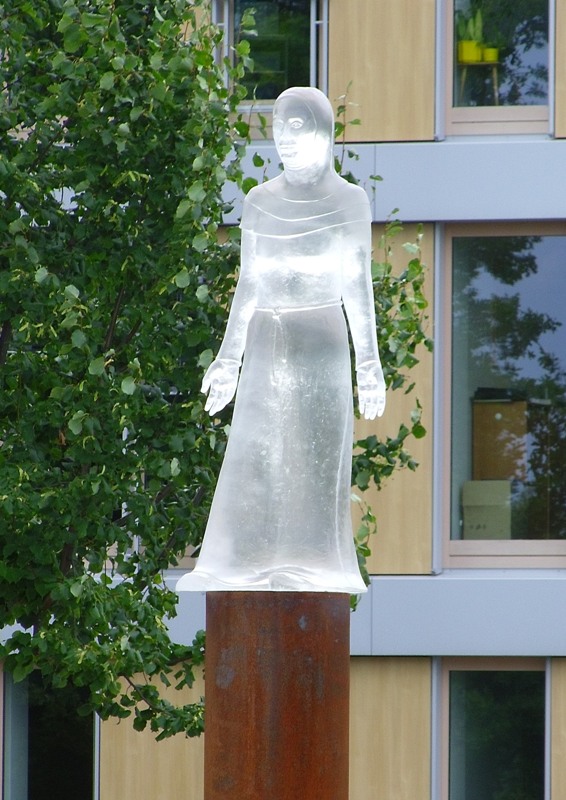
 There were sculptures everywhere, one of the most unusual being this glass statue.


On a miserable wet day we drove to Berlin which we visited over the weekend.  Our site was nearly thirty kilometres from the centre but we were able to get day tickets for our journey.  They cost about £6.00 each and gave us unlimited travel on the very efficient underground, trams or buses .

 We visited part of the Berlin wall where there is now a garden of remembrance in what was the death zone. 


The atmosphere there was very heavy and we found the photos and descriptions of those who had died trying to escape rather harrowing.

 Berlin has many neo-classical buildings as well as some very modern ones and we managed to see most of the well known tourist sites among which were:

Schloss Charlottenburg


The Jewish Museum housed in a very strange modern building which is intentionally disorientating


Checkpoint Charlie complete with phony American soldier and McDonalds behind it


And of course the Brandenburg Gate


Among the many statues, one of our favourites  was in the Victoria Park - Neptune wrestling with a mermaid caught in his net!


Just over the border into Poland is the town of Szczecin (Stettin in German) where we are staying at Campsite Marina and were blessed with warm sunshine and a lovely sunset.


Tomorrow we go towards Gdansk

Saturday, 16 July 2011

HERE WE GO AGAIN!

We are on our travels again – crossing the Channel tomorrow (Sunday) and heading across northern Germany where we will visit Berlin before going into Poland and up into Latvia, Lithuania and Estonia. 

During the last two and a half months we have enjoyed visiting family and friends and here are a few of the things we saw in between. 

Travelling to Scotland on the A68 we came to Jedbrough which has a huge ruined Abbey.


The whole of the centre of Jedbrough is a free WiFi hotspot – why aren’t all towns and cities so helpful?

We had two weeks on the Isle of Skye and in spite of heavy showers and very strong winds saw much of the island though the Cuillin mountains never appeared from the low cloud.  We did manage to walk up to the Old Man of Storr though.


While in Cornwall Jane photographed a beautiful Scarlet Tiger Moth in St Ives.


We visited the Maritime Museum in Falmouth


And walked up to an amazing rock formation on Bodmin Moor known as the Cheesewring.


On the Western edge of Dartmoor we visited the beautiful Lydford Gorge where we saw, among many other lovely things, the White Lady's waterfall


We will try to keep the blog updated as often as possible but as we are going into territory that is new to us we don’t know how often that will be.  Do keep coming back to see how we are getting on.

Saturday, 28 May 2011

BACK TO SOGGY SCOTLAND

For technical reasons we have been unable to update the blog till now but here is a brief post to bring you up to date:

Our journey through France was uneventful.  We spent a couple of nights at Amiens where we were able to cycle into the city along the canal towpath.  The cathedral is huge – twice the size of Notre Dame in Paris and the highest nave ceiling in France.  It also contains some lovely old carvings showing scenes from the Bible.


We crossed back to UK on the day of the Royal Wedding and as expected the motorways were relatively quiet for our journey to Derbyshire where our friends’ son Dave was getting married to Alex in the chapel of Newstead Abbey on the Sunday.  By coincidence there was a Napoleonic re-enactment taking place in the grounds.
 

We are now in Scotland (in the rain!) and soon returning to England, visiting family and friends for the next couple of months during which time we will decide where to go next.

Look out for our next blog in July.